When I began reading this story I enjoyed it, in fact I was reading it to my children. I soon realized that the Fairy Queen was not your typical "fairy tale". This was not a story to be read to children, and now that I know the purpose of this allegory, I would prefer not to read it. But alas, I have to.
One just doesn't realize how much the English hated, (hates?) the Catholic Church until you take an English Literature class, (it's really bad). Key phrase; "Edmund Spenser was an avid Nationalist", (Which really means "Catholic Hater").
Maybe this is too simplistic and I'm sure I have said it before; but how can the Catholic Church be the villain in any sense other than She would not allow Henry VIII to divorce? Essentially, the entire core of the Church of England is about a nutty, (an understatement), monarch who threw a major "hissy" fit because he could not get what he wanted, and the Catholic Church has been vilified ever since, (in England at least), for this reason.
Queen Mary was for Mommy and Queen Elizabeth was for Daddy, and Daddy/Elizabeth won. In my opinion, this is not something to be proud of, this history of religion in England. The Reformation according to Martin Luther is another story altogether.
Two things are particularly disturbing to me: Spenser's symbolic references to everything in the story that is evil, being the Catholic Church, i.e., Error's vomiting the "papers" containing the doctrines and dogma of the Church. The second being his belief that the "Whore of Babylon" is also the Catholic Church.
The Whore of Babylon is NOT the Catholic Church. Suffice it to say , the Catholic Church is the one true Church, the Bride of Christ. "So why is the Bride maligned as the Whore? Jesus himself answered the question: "If they have called the master of the house Beelzebul, how much more will they malign those of his household" (Matt. 10:25). "If the world hates you, know that it has hated me before it hated you. If you were of the world, the world would love its own; but because you are not of the world . . . the world hates you. Remember the word that I said to you, ‘A servant is not greater than his master.’ If they persecuted me, they will persecute you" (John 15:18–20). http://www.catholic.com/library/whore_of_babylon.asp
"There is irrefutable evidence in Revelation 17–18 (the chapters Fundamentalists love to quote against the Catholic Church) that proves that it is impossible for the Catholic Church to be the Whore." http://www.catholic.com/library/whore_of_babylon.asp
More about this in my next blog.
Friday, February 29, 2008

Wednesday, February 20, 2008
On Henry and Anne...
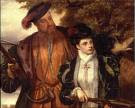
In reading Henry VIII's love letters to Anne Boleyn, my first impression was that he is obsessed with her. It is difficult to know how she really felt about him because we cannot read the letters that she had written; what was he responding to, what was she saying to him? In every letter, he refers to her as his mistress, declares his undying love, and tells her he cannot wait to be with her.
An interesting note; a person learned in English history recently told me that the depictions of Anne Boleyn as a beautiful and sexy woman are completely false. Apparently, she was exceedingly ugly.
I do detect some insecurity and anxiety in his words. For example, "...for by absence we are kept a distance from one another, and yet it retains its fervour, at least on my side; I hope the like on yours..." and then, "...but for the firm hope I have of your unchangeable affection for me." Henry was obviously unsure. He then sends her a picture of himself "set in bracelets".
I think that there is a good chance that she really did not want him as much as her wanted her, at least at first. He was not one to be trusted as he was married, and rumor has it that her sister had just recently given birth to his son, Henry. It is terribly ironic that the first woman to give him a son, (Mary Boleyn), was not his wife and all those women had to have their heads chopped and be replaced by the next woman so that he could sire an heir.
In his second letter Henry writes, "I am sure that I have since never done anything to offend you, and it seems a very poor return for the great love which I bear you to keep me at a distance." I think she later was keeping him at a distance because she was waiting for him to obtain an annulment. That process took seven years and completely changed the world of Christianity; it caused the "irrevocable breach" of England from the Catholic Church.
The second thing that struck me was that after reading the love letters, it is hard to imagine that he would have her executed. The story is a very sad one and I found the following very interesting:
"This account of Anne Boleyn's speech at her execution. The execution took place on 19 May 1536 at 8 o'clock in the morning. It was the first public execution of an English queen.
I find the whole thing very creepy.
An interesting note; a person learned in English history recently told me that the depictions of Anne Boleyn as a beautiful and sexy woman are completely false. Apparently, she was exceedingly ugly.
I do detect some insecurity and anxiety in his words. For example, "...for by absence we are kept a distance from one another, and yet it retains its fervour, at least on my side; I hope the like on yours..." and then, "...but for the firm hope I have of your unchangeable affection for me." Henry was obviously unsure. He then sends her a picture of himself "set in bracelets".
I think that there is a good chance that she really did not want him as much as her wanted her, at least at first. He was not one to be trusted as he was married, and rumor has it that her sister had just recently given birth to his son, Henry. It is terribly ironic that the first woman to give him a son, (Mary Boleyn), was not his wife and all those women had to have their heads chopped and be replaced by the next woman so that he could sire an heir.
In his second letter Henry writes, "I am sure that I have since never done anything to offend you, and it seems a very poor return for the great love which I bear you to keep me at a distance." I think she later was keeping him at a distance because she was waiting for him to obtain an annulment. That process took seven years and completely changed the world of Christianity; it caused the "irrevocable breach" of England from the Catholic Church.
The second thing that struck me was that after reading the love letters, it is hard to imagine that he would have her executed. The story is a very sad one and I found the following very interesting:
"This account of Anne Boleyn's speech at her execution. The execution took place on 19 May 1536 at 8 o'clock in the morning. It was the first public execution of an English queen.
'Good Christian people, I am come hither to die, for according to the law, and by the law I am judged to die, and therefore I will speak nothing against it. I am come hither to accuse no man, nor to speak anything of that, whereof I am accused and condemned to die, but I pray God save the king and send him long to reign over you, for a gentler nor a more merciful prince was there never: and to me he was ever a good, a gentle and sovereign lord. And if any person will meddle of my cause, I require them to judge the best. And thus I take my leave of the world and of you all, and I heartily desire you all to pray for me. O Lord have mercy on me, to God I commend my soul.'
After being blindfolded and kneeling at the block, she repeated several times:
'To Jesus Christ I commend my soul; Lord Jesu receive my soul.' "1
I find the whole thing very creepy.
Sunday, February 17, 2008
A Sonnet
I don't think I have written a sonnet since high school and I really didn't think I could, but once I started writing, the words were flowing. So here goes:
How a Child Doth Break His Mother’s Heart
Oh how a child doth break his mother’s heart,
I pray if he could only be aware,
That the thoughtless words that flow from thee art,
The cruelest kind that bring pain to bear.
My Mother, says he, of you we have no need,
From love you do not act nor give of self,
But of your judgment you only pay heed;
As over concerned you are with our health.
Lo, we were very well before you came
No better or worse because you are here
My son, your words they sting, Have you no shame?
I bless your children and hold them so dear.
How can I express this heartbreaking pain?
To do so I can predict of no gain.
How a Child Doth Break His Mother’s Heart
Oh how a child doth break his mother’s heart,
I pray if he could only be aware,
That the thoughtless words that flow from thee art,
The cruelest kind that bring pain to bear.
My Mother, says he, of you we have no need,
From love you do not act nor give of self,
But of your judgment you only pay heed;
As over concerned you are with our health.
Lo, we were very well before you came
No better or worse because you are here
My son, your words they sting, Have you no shame?
I bless your children and hold them so dear.
How can I express this heartbreaking pain?
To do so I can predict of no gain.
Sunday, February 3, 2008
Courtier continued...
I really don't have anything else to say about The Book of the Courtier. I had written several paragraphs and somehow lost them, so I think I will move onto Henry's letters to Anne Boleyn.
Friday, February 1, 2008
The Courtier
A large topic in contemporary literature, courtiers were often regarded as marked by insincerity, skill at flattery and intrigue, ambition and lack of regard for the national interest. More positive aspects of the stereotype would include the role played by the court in the development of politeness - a concept in origin to close to that of the "politician" - and the arts.
In modern English, the term is often used metaphorically for contemporary political favourites or hangers-on. (http://www.reference.com/search?q=courtier)
The perfect courtier is to have an excellent mind, proper manners and manner of speaking, a good voice for speaking as well as singing, and a strong athletic physique.
The courtier should know how to draw, paint, and be knowledgeable in classical antiquity. All these skills and many more are executed with a certain "sprezzatura" or nonchalance. Why the perfect courtier? We shall see.
In modern English, the term is often used metaphorically for contemporary political favourites or hangers-on. (http://www.reference.com/search?q=courtier)
The perfect courtier is to have an excellent mind, proper manners and manner of speaking, a good voice for speaking as well as singing, and a strong athletic physique.
The courtier should know how to draw, paint, and be knowledgeable in classical antiquity. All these skills and many more are executed with a certain "sprezzatura" or nonchalance. Why the perfect courtier? We shall see.
Tuesday, January 29, 2008
Final thoughts on Book 2...
"Children stood by in absolute silence" during meals. That would be miraculous, but also unnatural and unrealistic as most of Utopia is. Also, Utopians cannot leave their district without permission and are "severely" punished if they try to do so. I would call this oppression, not freedom or equality.
"Their religious principles are of this nature: that the soul of man is immortal, and by God's goodness born for happiness; after this life, rewards are appointed for our virtues and good deeds, punishments for our sins." A form of Christianity.
OK, now it gets weird!
Thomas More was a devout Catholic, so this next passage was a little shocking. "But if the disease is not only incurable, but excruciatingly and continually painful, then the priests and public officials come and urge the invalid not to endure such agony any longer. They remind him that he is now unfit for any of life's duties. a burden to himself and to others; he has really outlived his own death...life is simply torture and the world a mere prison cell...death puts an end not to pleasure, but to agony. Those who have been persuaded by these arguments either starve themselves to death or take a potion which puts them painlessly to sleep..." This argument is used by proponents of euthanasia and assisted suicide; of which the Catholic Church teaches are mortal sins, (deserving of Hell). One must respect life, and not end it, from conception to natural death. (Catechism of the Catholic Church 2270, 2277, 2280). Again, frighteningly relevant to the 21st century.
Weird item #2: Utopians follow a custom which is indeed "foolish and absurd in the extreme", not to mention pretty shallow; "the bride-to-be is shown naked to the groom by a responsible and respectable matron: and, similarly, some respectable man presents the groom naked to his future bride." He then compares this practice to inspecting a horse and uncovering a "hidden sore". He warns against hating one's spouse for the rest of one's life based on surprises that may be hidden by clothing. This reminds me of something a 14 or 15 year-old person would say, thinking he or she was being very philosophical and articulate.
One last observation: More states that Utopia does not need lawyers, (whom he criticizes extensively) - and he is a lawyer in "real" life.
This book, in my opinion, is a political discourse about everything that was wrong with life in England, (and human nature), as Thomas More knew it. This "pie-in-the-sky" tale, (unrealistic as it is), is simply how he would like for life to be if he were in charge.
The End
"Their religious principles are of this nature: that the soul of man is immortal, and by God's goodness born for happiness; after this life, rewards are appointed for our virtues and good deeds, punishments for our sins." A form of Christianity.
OK, now it gets weird!
Thomas More was a devout Catholic, so this next passage was a little shocking. "But if the disease is not only incurable, but excruciatingly and continually painful, then the priests and public officials come and urge the invalid not to endure such agony any longer. They remind him that he is now unfit for any of life's duties. a burden to himself and to others; he has really outlived his own death...life is simply torture and the world a mere prison cell...death puts an end not to pleasure, but to agony. Those who have been persuaded by these arguments either starve themselves to death or take a potion which puts them painlessly to sleep..." This argument is used by proponents of euthanasia and assisted suicide; of which the Catholic Church teaches are mortal sins, (deserving of Hell). One must respect life, and not end it, from conception to natural death. (Catechism of the Catholic Church 2270, 2277, 2280). Again, frighteningly relevant to the 21st century.
Weird item #2: Utopians follow a custom which is indeed "foolish and absurd in the extreme", not to mention pretty shallow; "the bride-to-be is shown naked to the groom by a responsible and respectable matron: and, similarly, some respectable man presents the groom naked to his future bride." He then compares this practice to inspecting a horse and uncovering a "hidden sore". He warns against hating one's spouse for the rest of one's life based on surprises that may be hidden by clothing. This reminds me of something a 14 or 15 year-old person would say, thinking he or she was being very philosophical and articulate.
One last observation: More states that Utopia does not need lawyers, (whom he criticizes extensively) - and he is a lawyer in "real" life.
This book, in my opinion, is a political discourse about everything that was wrong with life in England, (and human nature), as Thomas More knew it. This "pie-in-the-sky" tale, (unrealistic as it is), is simply how he would like for life to be if he were in charge.
The End
Monday, January 28, 2008
Book 2 continued...
At first, I thought I would like to live in Utopia, (the older I get, the better it sounds), but now I'm not so sure. Everything is so regimented, that can be good or bad. I like the idea of a six hour work day; the rest of the hours in a day being productive, not idle.
"...hardly any of the women..., work." Hmmm. I agree with the footnote writer, this is a strange statement. What does More mean by "work"?
"...these sturdy and lusty beggars, who go about feigning some disease as an excuse for their idleness." Reminds one of current social issues in this country.
The following are two of the most appealing things about Utopia; no fear of hunger, and large public hospitals. In Utopia, "There is plenty of everything...” greed and avarice do not exist. There is more than enough food for everyone; no one takes more than they need. There is always a surplus to share with other, less fortunate countries.
Each city in Utopia has four large public hospitals so that there is plenty of room for the sick. "The hospitals are well-ordered and supplied with everything needed to cure the patients, who are nursed with tender and watchful care. Highly skilled physicians are in constant attendance." If only this could true. This is perfect socialized medicine, truly a fantasy.
"...hardly any of the women..., work." Hmmm. I agree with the footnote writer, this is a strange statement. What does More mean by "work"?
"...these sturdy and lusty beggars, who go about feigning some disease as an excuse for their idleness." Reminds one of current social issues in this country.
The following are two of the most appealing things about Utopia; no fear of hunger, and large public hospitals. In Utopia, "There is plenty of everything...” greed and avarice do not exist. There is more than enough food for everyone; no one takes more than they need. There is always a surplus to share with other, less fortunate countries.
Each city in Utopia has four large public hospitals so that there is plenty of room for the sick. "The hospitals are well-ordered and supplied with everything needed to cure the patients, who are nursed with tender and watchful care. Highly skilled physicians are in constant attendance." If only this could true. This is perfect socialized medicine, truly a fantasy.
Subscribe to:
Posts (Atom)